
15 February - 20 February 2027
Buenos Aires (Argentina)
The twenty-first century is marked by rapid changes amid uncertainty. Alongside environmental and military destruction, institutions once responsible for ensuring order, progress, peace, equality, social justice, and liberal democracy are collapsing. The landscape is shaped by inequalities, ecological crises, technological advancements, and the rise of authoritarian political and economic regimes. In this context, religion has emerged as a space for public meaning-making, political imagination, and discussions about the future—straddling the line between salvation and catastrophe, between restoring order and exploring new possibilities.
This conference begins with a series of questions: What kinds of religious and spiritual performances manifest in a world characterized by fragmentation and the rise of authoritarianism? In what ways do myths, rituals, and religious aesthetics influence worldviews that determine which lives are valued and protected? What roles do religions and their secularized versions assume in reimagining authority, charisma, and community during periods of disenchantment and democratic crisis? Additionally, what narratives and practices do religions foster when confronting war, violence, and poverty?
Rituals, bodies, and images do more than just express faith; they also shape worlds, define what is seen and said, and create communities and boundaries. In modern societies, religious performativity acts as a tool of possibility: it can strengthen fantasies of restored purity or cultivate imaginaries of coexistence, repair, and planetary care.
The conference encourages examining current beliefs, fears, and hopes. In times of division, weakened multilateralism, and democratic challenges, religions and spiritualities reshape the languages of authority, order, resistance, and life. Investigating their performative aspects includes questioning how narratives about worlds ending are constructed and how new beginnings are enacted amidst destruction.
Conference timeline:
The twenty-first-century advances amid uncertainty. Alongside environmental and military destruction, we see the breakdown of institutions that once supported promises of order, progress, peace, equality, social justice, and liberal democracy. Extreme wealth disparities, multiple inequalities, ecological collapse, technological expansion, and the rise of authoritarian political and economic systems shape a landscape of crisis and global change. In this setting, religion has become a domain of public meaning-making, political imagination, and debate about the future—wavering between salvation and disaster, between restoring order and embracing new possibilities. The reflection unfolds across three levels.
Worlds at the brink. The sense of ecological, institutional, and epistemic collapse gives rise to forms of religiosity marked by urgency and mourning. In a social climate driven by negative emotions like fear and resentment, stories of national, racial, or moral salvation spread. In these visions, religion combines with technocratic, militarized, or conspiratorial discourses, in which faith in algorithms or charismatic leaders competes with democratic debate.
Performativity. In the religious–political sphere, gestures, protests, bodies, and affects hold constitutive power. The performance of authority, from religious leaders to finance and crypto-economics figures, takes the form of rituals of purification, productivity, and control. This theatrical display of power establishes social order and justifies hierarchies—based on gender, race, or nation—while also exposing flaws that allow impure, hybrid, popular, inter-religious, or subaltern practices to emerge, transcending the boundaries of the human and the sacred.
Future-making. In this context, religion provides frameworks for imagining future horizons of action. From transhumanist dystopias to Indigenous cosmopolitics, from discourses of holy war to spiritualities of planetary care, visions of the future and universal fraternity multiply. Religions, spiritualities, and the sacred become arenas of conflict where geopolitical projects, clashing ontologies, and global aesthetic sensibilities confront each other. To think about religion today is to examine how the boundaries between human and non-human, between lives protected and lives discarded, and between the person as a commodity and the person as sacred are performed. Thinking with religion thus involves questioning how worlds come to an end and how, amid ruins, possible beginnings are rehearsed.
A registration desk will be provided at the Faculty of Social Sciences, University of Buenos Aires (Santiago del Estero 1029) during the conference days.
The registration desk’s opening hours:
(*) members from countries with non-convertible currency, students, retired colleagues, unemployed and partners of full members.
(**) Non-members assisting without presenting a paper.
Buenos Aires is Argentina’s political and cultural capital and a major hub for academic, artistic, and intellectual life. The city is socially and religiously diverse, offering a rich context for international scholarly exchange and comparative discussions on belief, secularization, and social change.
Renowned for its architectural diversity and cultural scene, its urban landscape combines European-inspired avenues with contemporary design. Cultural activity includes large-scale productions as well as independent theatres, cultural centres, and museums. Festivals, concerts, and public events take place throughout the year and often extend into the evening, contributing to its reputation as a city that never sleeps.
The city is also one of Latin America’s most important gastronomic hubs. Traditional porteño cuisine—particularly Argentina’s renowned beef served in local parrillas—coexists with a wide range of regional and international culinary options. Historic cafés and long-established pizzerias, especially along Avenida Corrientes, are central to everyday urban life.
Sport plays a central role in the local cultural imagination. Buenos Aires hosts major international events, including world-class polo and tennis tournaments, and is home to the celebrated football rivalry between River Plate and Boca Juniors.
The city is easily accessible, with two international airports and extensive public transportation. Its hospitality infrastructure—ranging from hotels to cultural institutions—supports the needs of academic visitors. It provides a diverse urban context for academic exchange, combining strong institutional infrastructures with a rich cultural and social environment.
Buenos Aires is a safe, modern city with good-quality healthcare services. There are no major health risks, and no vaccinations are required for entry into Argentina. Tap water is safe to drink throughout the city.
Public and private hospitals operate across Buenos Aires. Access to healthcare services for foreign visitors is subject to the health insurance requirements outlined above.
In case of a medical emergency, ambulances can be requested free of charge by calling 107, available 24 hours a day.
Interpretation services are available in English, Portuguese, French, Italian and Japanese.
As in any large metropolitan city, petty crime and theft can occur, and visitors are advised to take standard precautions, particularly in tourist areas and crowded places. We recommend keeping personal belongings with you at all times, using licensed taxis or ride-hailing services, and ensuring that bags and backpacks remain closed. Stick to well-lit streets in the evening and avoid displaying valuables.
In case of emergency, call 911.
For non-emergency assistance, the following services are available:
If you experience any form of abuse, mistreatment or discrimination during your visit, you may contact the Tourist Ombudsman, the public office responsible for protecting tourists’ rights.
Tourist Assistance Centres are also available in Recoleta and Puerto Madero.
The Tourist Police Station assist visitors with lost items, theft, missing persons and other incidents, and can help contact embassies or consulates if needed.
Argentina’s national currency is the Argentine peso (ARS). It uses the same symbol ($) as the US dollar; unless otherwise specified, prices marked with “$” are in Argentine pesos. US dollars are usually indicated as U$S.
Most hotels and many shops accept credit or debit cards, although some smaller businesses may accept cash only.
Local currency can be obtained at casas de cambio (currency exchange offices) and at most banks (identification is required). Cash can also be withdrawn from ATMs throughout the city, which operate 24 hours a day and accept major international cards.
In the central financial district, particularly along Calle Florida, informal money changers may offer exchange services. These operators are illegal, and for safety reasons, visitors are strongly advised to exchange money only at authorised institutions.
We recommend changing small amounts at a time and keeping transaction receipts, which may be required if you wish to exchange pesos back into foreign currency. At departure, exchanges back into foreign currency are generally limited to the equivalent of USD 100 in cash.
Argentina operates on UTC/GMT-3, with no daylight saving time. Daily activity in Buenos Aires generally starts early and extends late into the evening.
Electricity supply in Argentina is 220–240 volts (AC). Power sockets use plugs with two or three flat pins, with the top pins angled. Visitors are advised to bring suitable adapters.
Travellers are therefore advised to carry adapters and/or transformers.
The international country code for Argentina is 54, and the area code for Buenos Aires is 11.
For domestic calls within Argentina, dial 0, followed by the area code and number. For international calls from Argentina, dial 00 before the country code.
Prepaid SIM cards can be purchased at mobile phone stores and many kiosks. The main mobile networks are Personal, Movistar and Claro.
Buenos Aires offers over 250 free public Wi-Fi hotspots, including on subway and bus networks. Many cafés, bars and restaurants also provide free Wi-Fi for customers.
The University of Buenos Aires (UBA), founded in 1821, is the largest public university in Argentina. It is considered to be one of the most prestigious study centers in America and the world. Since the mid-twentieth century, its tuition-free and unrestricted access model has expanded access to higher education while maintaining high academic standards.
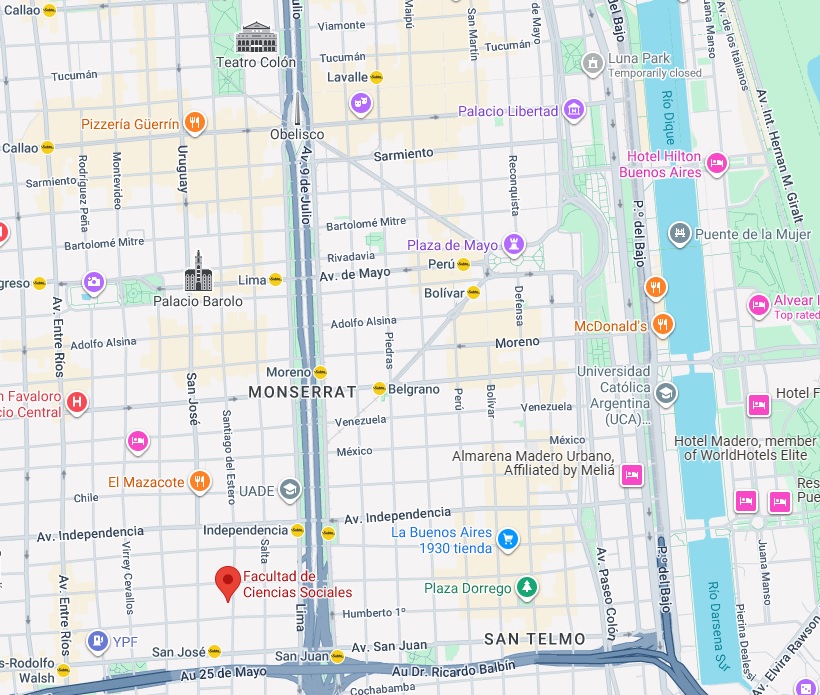
Buenos Aires offers a wide range of cultural attractions, and we encourage participants to visit its main sights.
One of the most important opera houses in the world, Teatro Colón is internationally renowned for its acoustics and architecture. Opened in 1908, it has hosted leading musicians, conductors and dancers throughout the twentieth century.
Casa Rosada is the seat of the Argentine national government and the President’s office. Located in Plaza de Mayo, it has played a central role in the country’s political history since the nineteenth century.
The Cabildo de Buenos Aires was the centre of Spanish colonial administration and a key site during the May Revolution of 1810. Today, it houses a national museum dedicated to Argentina’s colonial and early independence periods.
Facing Plaza de Mayo, the Metropolitan Cathedral is the Catholic Church’s main site in Argentina, It was the site where Pope Francis officiated mass before assuming office in the Vatican in 2013 and now includes a museum which exhibits some of his personal and liturgical objects.
The Obelisco de Buenos Aires is one of the city’s most iconic landmarks. Located at the intersection of Avenida 9 de Julio and Avenida Corrientes, it was erected in 1936 to commemorate the fourth centenary of the first foundation of Buenos Aires and marks the site where the Argentine national flag was raised in the city for the first time
Recoleta Cemetery is one of Buenos Aires’ most visited historical sites. Known for its monumental mausoleums and architectural diversity, it is the burial place of prominent national figures, including Eva Perón.
San Telmo is one of Buenos Aires’ oldest neighbourhoods and includes much of the city’s historic district. The area is known for its colonial-era architecture, cobblestone streets and strong local identity. Historically associated with the city’s port and immigrant past, San Telmo combines older buildings with antique shops, galleries, cafés and cultural spaces. On Sundays, the neighbourhood hosts a street market around Plaza Dorrego, featuring antiques, crafts and live performances.
Located in the Puerto Madero district, Puente de la Mujer is a rotating pedestrian bridge designed by Spanish architect Santiago Calatrava. It has become a symbol of the city’s contemporary urban renewal. Its design is inspired by the figures of a tango-dancing couple, and its turning mechanism allows sailing vessels to pass through the dock.
Located in the La Boca neighbourhood, Caminito is an open-air street museum known for its brightly coloured buildings and artistic heritage. The area reflects the city’s immigrant and portside history and became a cultural landmark in the mid-twentieth century through the work of local artists, particularly Benito Quinquela Martín.
La Bombonera, officially known as Estadio Alberto J. Armando, is the home stadium of Boca Juniors, one of Argentina’s most prominent football teams. Located in the La Boca neighbourhood near Caminito, it is known for its steep stands and distinctive design. It is historically associated with Diego Maradona and houses a museum dedicated to the club.
El Ateneo Grand Splendid is a bookstore housed in a former theatre dating from 1919. Frequently ranked among the most beautiful bookstores in the world, it preserves much of its original architectural design.
The National Museum of Fine Arts houses one of the most important art collections in Latin America, including the largest collection of Argentine art. Located in the Recoleta neighbourhood, its permanent collection features works by major European and Argentine artists, alongside exhibitions of photography, sculpture and pre-Columbian art. Founded in 1896, the museum has been located at its current site since 1933.
Located in Parque Tres de Febrero, El Rosedal features more than 18,000 roses and has received international recognition for its landscape design. It is one of the city’s most popular public parks.
Located in Parque Tres de Febrero in the Palermo neighbourhood, the Galileo Galilei Planetarium is one of Buenos Aires’ main science and education landmarks. Opened in the 1960s and renovated in 2017, it features a large projection dome, interactive exhibits and audiovisual shows focused on astronomy and space science.
The Estadio Alberto J. Armando, as it is officially designated, is the home of Maradona’s beloved Boca Juniors team and is frequently regarded as the stadium with the most intense and passionate atmosphere in the world. The stadium is conveniently located in close proximity to the renowned Caminito of La Boca and is referred to as La Bombonera (“the chocolate box”) due to its distinctive ‘D’ shape and steep sides, which contribute to its exceptional acoustics. The stands are located in close proximity to the pitch, with only a narrow space separating the spectators from the field of play, creating an exceptional atmosphere during matches.
El Monumental is the home stadium of River Plate, one of Argentina’s most prominent football teams. Located in the Núñez neighbourhood, it is the largest stadium in the country and a regular venue for Argentina’s national team matches. Opened in 1938 and expanded for the 1978 FIFA World Cup, it also houses the River Plate Museum and hosts major cultural and musical events.
Covering 350 hectares, the Costanera Sur Ecological Reserve is the largest green space in the city. It offers walking paths and opportunities to observe local flora and fauna close to the city centre.
Parque Lezama is a traditional public park in the San Telmo neighbourhood and houses the National Historical Museum. The site is often associated with the first foundation of Buenos Aires in 1536 and remains an important public space in the southern part of the city.
Palacio Barolo is a landmark office building inspired by Dante Alighieri’s Divine Comedy, organised into three sections representing Hell, Purgatory and Paradise. It was inaugurated in 1923 and was the tallest building in South America at the time.
Source: https://turismo.buenosaires.gob.ar/en/recorrido/must-see-attractions
Visitors of many nationalities may enter Argentina for up to 90 days without a visa. To check whether a visa is required for your nationality, please consult the official information provided by the Argentine authorities or your local embassy or consulate.
Citizens of Mercosur countries may enter Argentina using only their national ID card.
Argentina no longer charges reciprocity fees to citizens of the United States, Canada or Australia.
According to Decree of Necessity and Urgency (DNU) No. 366/2025, issued in 2025, by the Argentine government, valid travel medical insurance is mandatory for all foreign visitors who are not permanent residents to enter the country.
All non-resident foreign nationals must have medical insurance covering healthcare expenses for the entire duration of their stay in Argentina. Failure to present proof of coverage may result in denial of entry.
Visitors may be required to:
In addition, under this regulation, non-resident foreign visitors are not entitled to access public healthcare services without insurance, unless they pay for medical services in advance.
This requirement applies to:
Permanent residents and Argentine citizens are exempt from this requirement.
We strongly recommend that participants arrange appropriate travel medical insurance before travelling and carry digital or printed copies of their insurance documentation.
President : Verónica Giménez Béliveau
Members :
